
Focus is not disappearing, it is Fragmenting
For many people, focus no longer feels like a stable state. It feels temporary. Brief. Fragile.
A task starts, then attention slips. Another tab opens. A message is checked. A new idea appears. The original task is still there, but it now feels heavier than it did a moment ago.
This is often interpreted as distraction or lack of discipline. But underneath it is a more consistent pattern: attention is being pulled by a loop between effort, friction, and escape.
The core mechanism: the friction–escape loop
Attention tends to break at a predictable point: friction.
Friction appears when a task requires:
- uncertainty
- sustained effort
- emotional discomfort
- cognitive output without immediate reward
- delayed progress
At that moment, the brain generates a subtle signal: “This is harder than what is available right now.”
When the nervous system is overloaded, it naturally moves toward relief (away from friction and toward whatever feels easier to process in the moment).
And in modern environments, relief and ease is always available.
So attention shifts.
Not because the task is unimportant, but because the brain has found a lower-friction alternative that delivers a small, immediate dopamine signal. Dopamine is a neurotransmitter involved in motivation and reward learning; it reinforces behaviors that feel relieving or engaging, making the brain more likely to repeat them.
How the Brain Learns What to Repeat
Dopamine is not simply about pleasure. It is more accurately involved in motivation and behavioral direction—helping the brain decide what to move toward and what to repeat.
It helps the brain decide:
- what to approach
- what to continue
- what to switch to next
High-dopamine inputs today are usually:
- short-form content
- rapid novelty feeds
- messages and notifications
- switching between stimuli
These do not just feel good. They feel available and low resistance.
So when a task becomes difficult, the mind does not stay in discomfort. It reorients toward something that feels immediately accessible.
The modern attention environment versus previous environments
In earlier environments, boredom or friction still had escape routes available, but they were slower and less stimulating in comparison such as doodling, daydreaming, or shifting into another simple activity instead of continuing a difficult task. The difference is not the presence of escape, but the intensity and immediacy of relief available through modern, high-stimulation alternatives.
Now, there is always a convenient release valve:
- a phone within arms reach
- a feed
- a message thread connecting you to a large social ecosystem
- a new tab for interesting searches
- an AI chatbot for stimulating inquiries
This changes the structure of attention itself.
The modern pattern becomes:
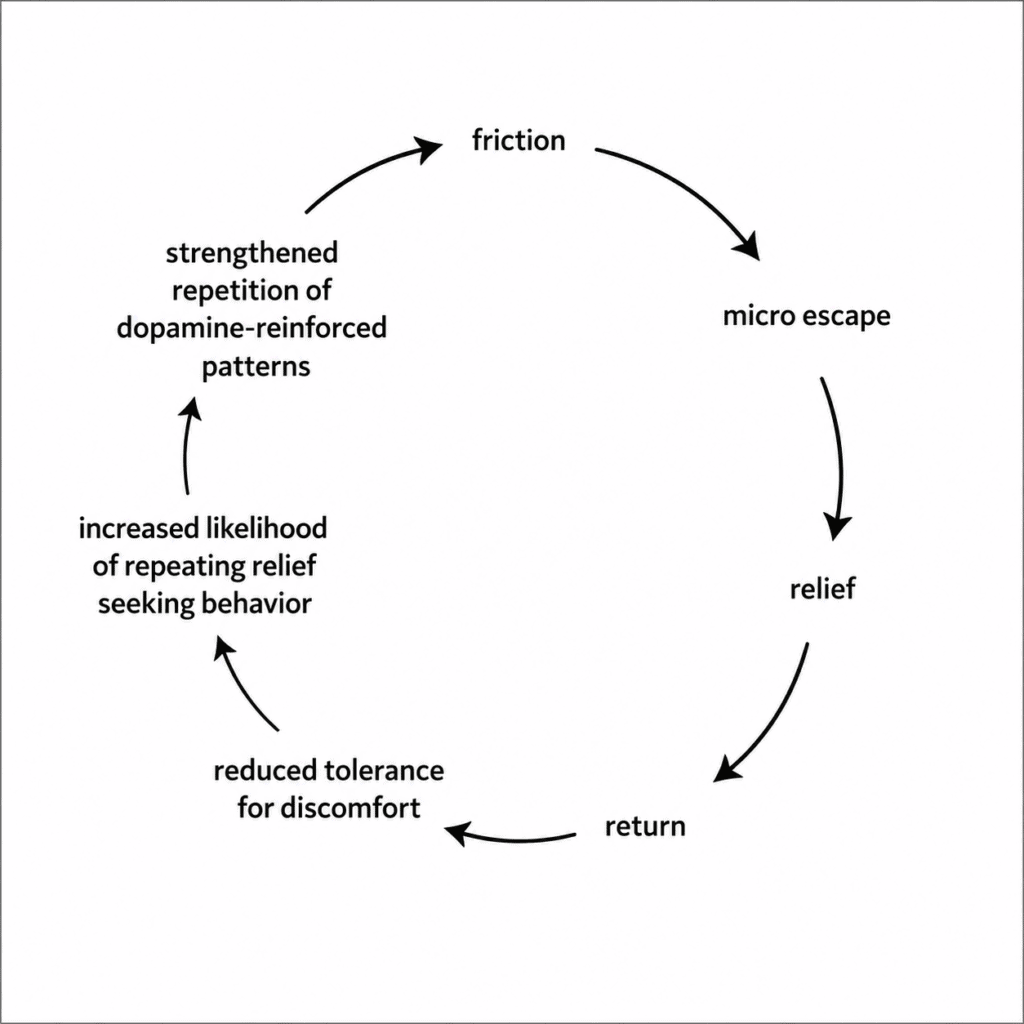
Why returning to tasks feels harder than starting them
A key pattern is that returning to a task after interruption feels disproportionately difficult.
This happens because:
- the original cognitive thread is partially lost
- re-entry requires rebuilding context
- emotional friction is now higher than before
Each interruption increases the “cost” of re-entry.
So attention gradually shifts away from depth and toward tasks that require less re-entry effort.
What this does to lived experience
Over time, this pattern produces a familiar internal experience:
- feeling busy but not progressing
- constantly switching but not finishing
- needing stimulation to begin tasks
- losing momentum quickly
- feeling mentally scattered without obvious cause
Conclusion: attention is responding normally to an abnormal environment
Focus is not failing because people lack discipline or are inherently flawed.
It is fragmenting because attention is being continuously pulled between:
- effort and friction
- relief and stimulation
- continuity and interruption
The brain naturally chooses relief when it is always available. The challenge is to to rebuild conditions where sustained attention can exist long enough to complete a thought, a task, or a moment of deep focus without giving into the compulsion to escape.

About the Author
Jessica Miskiewicz is a Canadian Registered Clinical Counsellor, Psychotherapist and Owner of Journey Therapy. She integrates neuroscience-informed insights into her virtual therapy practice, helping individuals understand how compulsive behaviors develop and are maintained in the brain. Jessica’s values-based approach supports individuals in rewiring unhelpful patterns, increasing self-awareness, and fostering lasting change through evidence-based strategies. Learn more at Journey Therapy or book a Free 15 minute consultation.